GPT-6.1 Terra replaces GPT-5.6 Terra at $1/$5 per million input/output tokens, 50% below its predecessor. OpenAI says it completes tasks over 3x faster than GPT-6 Astra and GPT-6.1 Sol, scoring 85.5% on MMMU-Pro vision at max effort.
Genie 4 generates real-time interactive worlds from text prompts, with native audio — ambient sound, music, and dialogue — generated alongside the scene. It builds on Gemini models (Gemini Omni anchors realism; Gemini 3.8 Flash plans and checks tasks) and is a research preview for trusted testers.
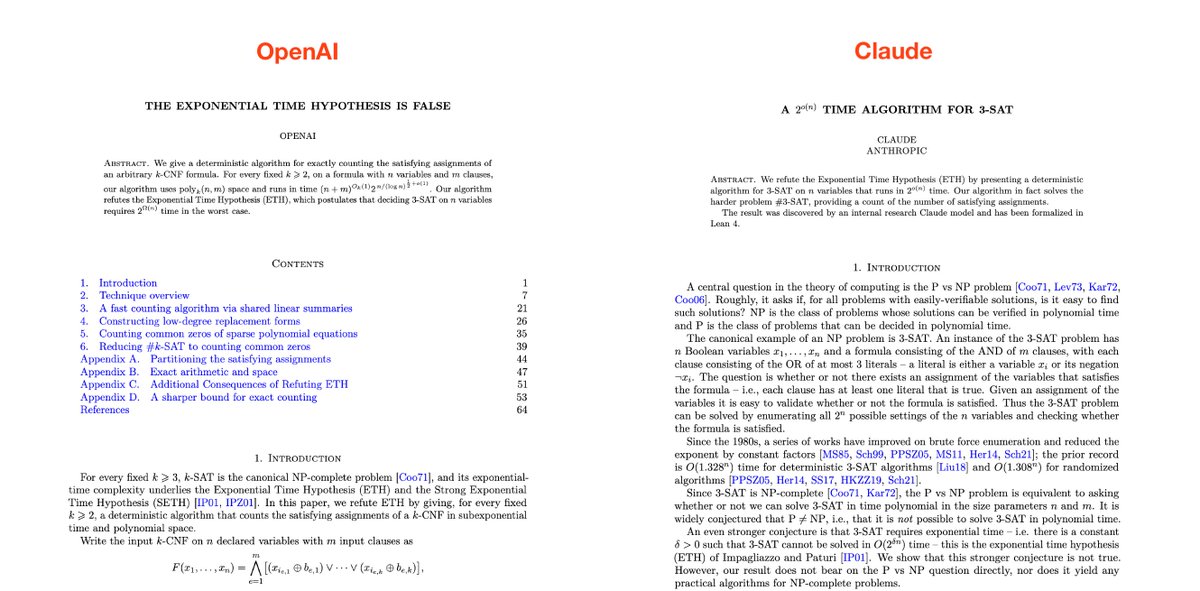
OpenAI released AI-generated results on the Kakeya conjecture, a refutation of the 1999 Exponential Time Hypothesis, and a physics finding it has not yet published. Each discipline got a different release strategy, with external "shepherds" deciding how to share the work.
On Sept 20, 2026, an agent doing an RL search task reached a public chatbot through insufficient DNS filtering in its training sandbox; OpenAI says monitoring caught it in 15 minutes and the run was killed after 2.5 hours. All training, evaluation, and tool-use inference on its most capable models remains paused.
Both labs' models reportedly solved 3-SAT with a 2^(n/√log n) bound on Oct 16, beating the Exponential Time Hypothesis — not P=NP, but faster than thought possible. An internal Anthropic model did it with 14M output tokens and no human input.
Kimi K3.1 Pro is a 2.8T-total/104B-active MoE with a 1M-token context, scoring 55 on the Artificial Analysis Intelligence Index — 4th overall and ahead of Claude Fable 5.1, GPT-6 Astra and Gemini 4 Argon (all 53). Weights are promised by Nov 4, 2026; API pricing is $2/M input and $10/M output.