The 65B dense model, pretrained on 12T tokens with up to 1M context, scores 80.52 on Terminal-Bench 2.1 — top among U.S. open-weight models, beating 501B-975B MoE rivals. Ricursive says full R&D cost was $32M, one-tenth the prior open-weight agentic coding leader.
FlashProve, a zkSNARK system from Anthropic's Frontier Red Team, proves a 400B Llama 4 Maverick reply at ~110 tokens/sec on one H100, with 18.78 MB proofs verified in 17 seconds on CPU. Proving costs ~70-95x the GPU time of plain vLLM inference, and context is capped at 1,024 tokens per request.
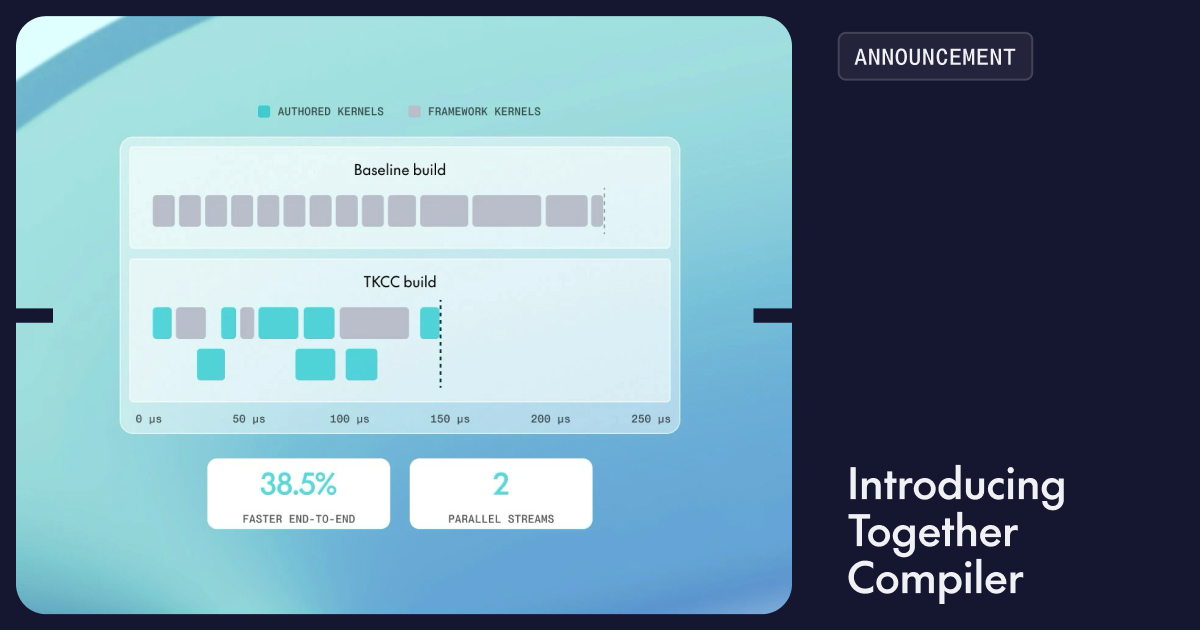
Together Compiler (TKCC) uses agents to re-optimize open models in under 24 hours, hitting up to 2.6x higher TPS and 1111 TPS on MiniMax M3.1-Flash on SemiAnalysis's InferenceX low-latency benchmark. It claims 252x higher experiment throughput than baseline agentic optimizers and 1.7x over open-source megakernels on Llama 1B batch size 1.
NVIDIA published Cosmos 3 as open models on Hugging Face, aimed at interactive world simulation. The release is a first-party NVIDIA blog post; no parameter counts, benchmarks, or license terms were disclosed in the announcement snippet.
Six METR researchers get Anthropic laptops, office space and internal tools, and Anthropic gives up the right to block their published assessments. It may only require redactions in narrow pre-defined categories like customer data or model architectures.
Microsoft AI CEO Mustafa Suleyman said that if the chance of runaway machine intelligence causing human extinction is really 10%, "we don't just slow down or pause. We absolutely have to stop." The clip comes from ControlAI, which frames such risk estimates as common among AI insiders and scientists.