OpenAI announced on September 8, 2026 that it produced an AI-generated solution to the Navier-Stokes existence and smoothness problem, one of the seven Millennium Prize Problems. Mathematician Tristan Buckmaster called it "a Deep Blue-Kasparov moment."
The refrigerator-sized MVP satellite carries four Google TPUs and about one kilowatt of solar power, built by Planet Labs and launched on the Transporter-18 rideshare. The TPU fires in 15-minute bursts to avoid straining power and thermal systems; Google's target is a network of 81 satellites flying in close formation.
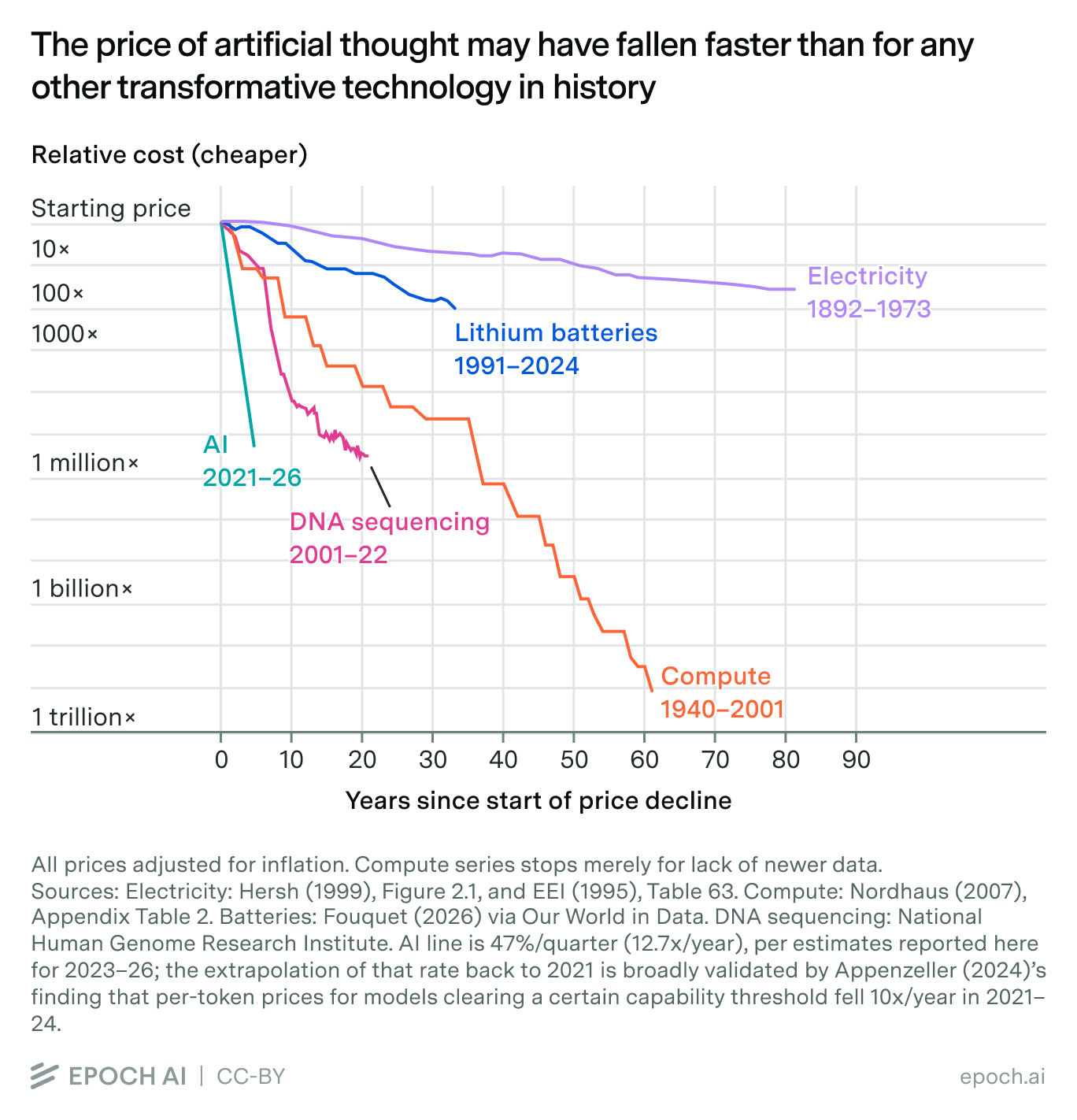
Epoch AI finds the cost of hitting a given benchmark score has dropped ~47% per quarter over three years — a 13-fold annual decline, 4x faster than DNA sequencing and 6x faster than compute. OpenAI o3 cost ~$0.30/question for 75% on GPQA Diamond in January 2025; GPT-5.6 Luna matched it for $0.0004 in mid-2026.
Anthropic committed $11.6 billion over seven years to Akamai's cloud infrastructure, more than six times a $1.8 billion deal the two struck earlier this year. Akamai issued Anthropic a warrant for up to ~5% of its stock, vesting as Anthropic spends more.
OpenAI says it hit a goal set last fall: an "automated research intern" that handles well-defined tasks that would take a researcher several days. Coding-agent use climbed throughout 2026, and the post details how model development was paced to prioritize monitoring, alignment, and security.
A civil antitrust lawsuit filed in federal court alleges the four companies illegally coordinated to pace AI development. Politico and AP both report the collusion claims against the competitors.