MIT CSAIL: GPT-6 Astra edits Qwen3.5-0.8B weights, MATH-500 7.9% to 48.1%
Read original source →venturebeat.com
Four MIT CSAIL researchers report GPT-6 Astra read and wrote Qwen3.5-0.8B's weights directly, changing just 0.016% of them to lift MATH-500 from 7.9% to 48.1% with no gradients or training loop. The authors say the edit mostly removed a failure mode, and all experiments but the Qwen one were small.
4 sources
'Like gene editing for neural networks': MIT researchers used GPT-6 Astra to edit Qwen's open weights directly, boosting math performanceventurebeat.com
GPT-6 Astra Edits Qwen Weights: MATH-500 7.9% to 48.1%explainx.ai
If this holds up, it is big: "We asked GPT-6 Astra to edit Qwen3.5-0.8B weights to improve math. It...bsky.app
MIT researchers say GPT-6 Astra improved a small Qwen model’s math score from 7.9% to 48.1% by directly editing just 0.016% of its weights, without gradient-based training.x.com
More stories today
Muse turns camera photos into product shots
Alexandr Wang·1 hour ago
Hebbia tests GPT-6 Astra on financial research, cites double-digit gains
In Hebbia's prerelease tests, GPT-6 Astra led the best alternative by 13.6 percentage points on required source types cited and 14.4 points on presentation requirements. Cited excerpts were relevant 99.5% of the time, and 97.9% of applicable presentation requirements were met.
OpenAI Blog·1 hour ago
Ultrafast mode on ChatGPT Pro 200 speeds up GPT-6.2 Astra and Sol builds
OpenAI Developers·2 hours agoStandard Bank Group automates generative AI risk assessment on AWS
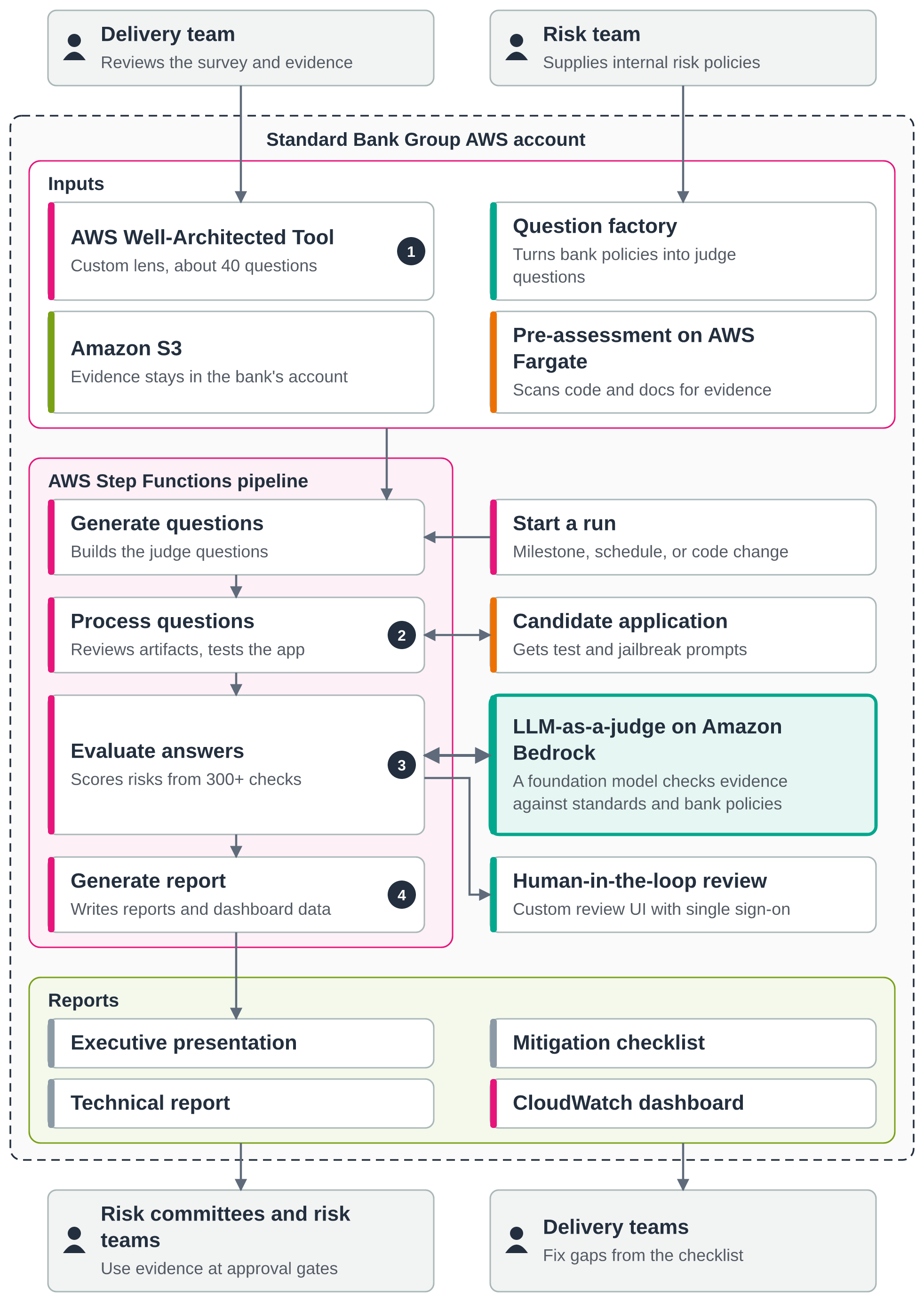
Standard Bank Group built an automated system on AWS that checks each generative AI use case against its AI policy, a process it says can now be stood up in days. The post is co-written by Tala Qraitem of AWS and Jörg Fischer of Standard Bank Group.
AWS AI Blog·2 hours ago
Amazon Textract Insights adds verifiable generative AI for documents
AWS launched Textract Insights, extending its document-processing service beyond text extraction to generative AI output aimed at financial services, insurance, healthcare and public-sector workflows. AWS says the results are verifiable.

METR's updated time-horizon report finds AI still improving exponentially
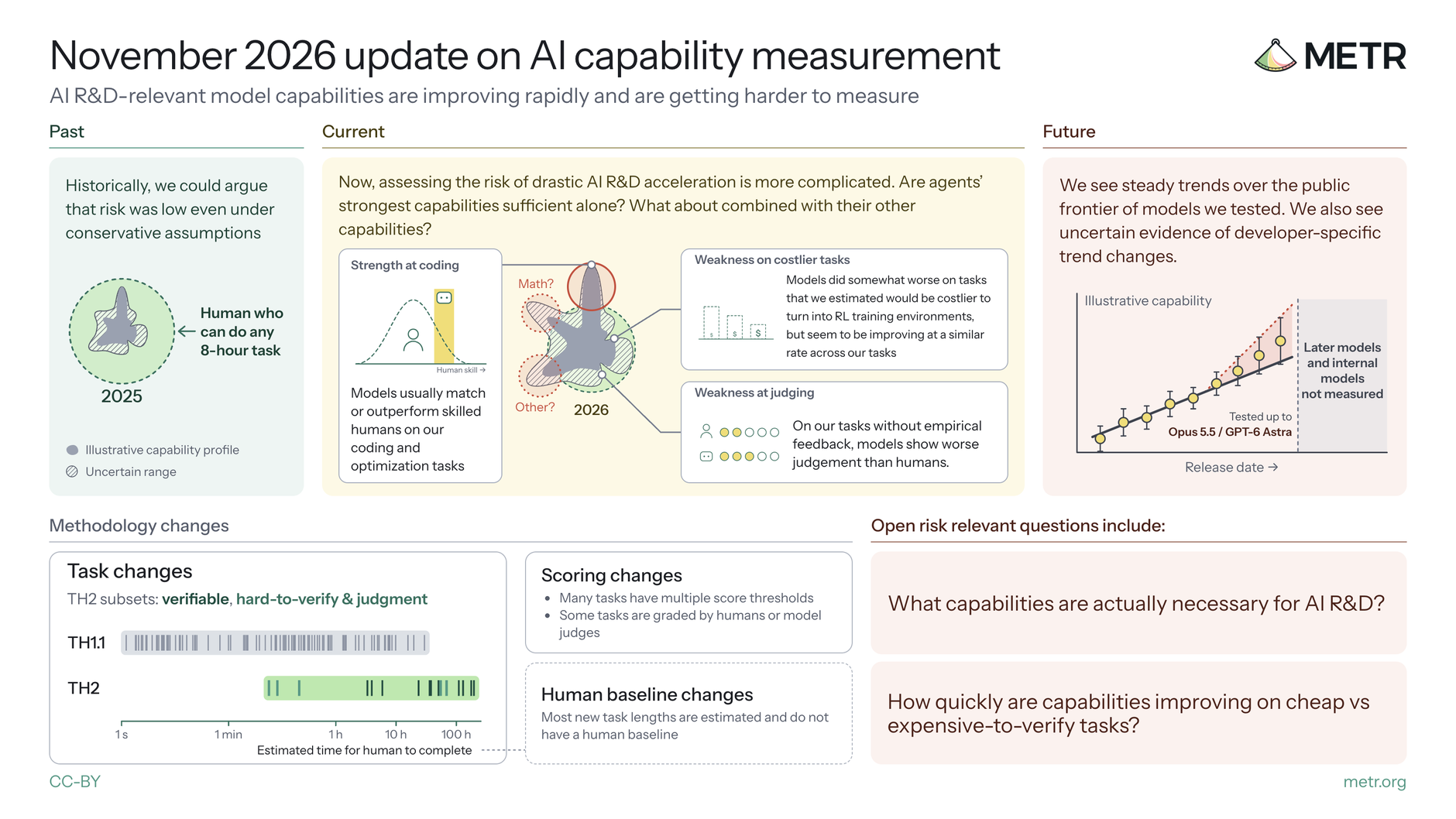
METR's update to its time horizon plot, covering models up to Opus 5.5 and GPT-6 Astra, adds longer and more open-ended tasks; the original showed task length doubling every four months. Models match or beat skilled humans on coding and optimization tasks but lag on judgment-heavy work.
METR·2 hours ago
Apple releases Depth Pro 2 for sharp, temporally consistent monocular depth
A single scalable network predicts dense metric depth for images and video at native resolution, jointly improving metric accuracy, boundary sharpness, and temporal consistency. Apple says prior methods trade consistency for sharpness; Depth Pro 2 claims a new Pareto frontier across accuracy, sharpness, consistency, and runtime, with code and weights released.
Apple ML Research·2 hours ago

Ramp's Inspect agent writes ~75% of company code
Zach Bruggeman says Inspect now writes and ships around 75% of Ramp's code, per his CODE Summit 2026 talk. He credits shared agent tooling, open internal sessions and visible verification, citing a telemetry bug and the Review Buddy code review agent.
YouTube·2 hours ago