Daily AI Briefing

Sunday, August 16, 2026

The 72 stories that mattered in AI, curated and summarized from dozens of sources by AIBriefs.

LaunchVisual AI15 sources

ByteDance Seedance 2.5 launches in 1080p across platforms

Seedance 2.5 generates 30-second audio-video clips in one pass, doubling from 15, with up to 30 images, 10 video clips, and 10 audio clips per pass. Now live on Runway, Together AI, Pika, and Atlas Cloud, with 1080p support and up to 60% cheaper pricing.

LaunchAI Models4 sources

RedNote open-sources dots3-note Preview, 280B multimodal MoE for agents

The first open-weight model in the dots3 family, it runs 16B activated parameters with 512K-token context and text, image, video, and audio understanding. Its TEMPO reinforcement-learning method lets agents critique their own progress and update memory during hour-long tasks.

LaunchVisual AI1 source

China's MiniMax and ByteDance Release Dueling AI Video Models

MiniMax Group Inc. and ByteDance Ltd. released updates to their AI video generation models within hours of each other, with Bloomberg reporting that aggressive advances have made China the leader over the US in the category.

EventBusiness8 sources

Jeff Dean leaves Google to found AI startup Discovery Loop

Dean, Google's chief scientist for 27 years, co-founds the company with Sanjay Ghemawat, Quoc Le, and Oriol Vinyals. Backed by Radical Ventures and Khosla Ventures — with Kleiner Perkins, Lightspeed, and Doerr Capital — it plans to automate complete experimental loops to accelerate science and engineering; Alphabet will take a stake.

LaunchDevelopers1 source

Meta launches Muse Code, an AI agent for large code bases

In beta and installed with a single command, Muse Code handles complex tasks across large repos by spawning parallel sub-agents in isolated worktrees. Meta AI chief Alexandr Wang says it's a cost-effective option versus OpenAI's Codex and Anthropic's Claude Code.

LaunchAI Models1 source

Alibaba's Qwen3.7-flash vision-language model appears on OpenRouter

Qwen3.7-flash is live on OpenRouter at $0.03/$0.13 per 1M tokens with a native 1M context window — substantially cheaper than Qwen3.6-flash. The vision-language reasoning model, released July 27, targets multimodal agents, visual coding, and computer interaction.

LaunchAI Models3 sources

Google releases three new Gemini models — but no 3.5 Pro

Google shipped Gemini 3.6 Flash, 3.5 Flash-Lite, and Flash Cyber, while Gemini 3.5 Pro remains absent. Google AI calls 3.5 Flash-Lite its fastest, most cost-effective model, optimized for high-speed agentic workflows.

AnalysisAI Models1 source

Claude Opus 5 builds 3D worlds and sims from one prompt

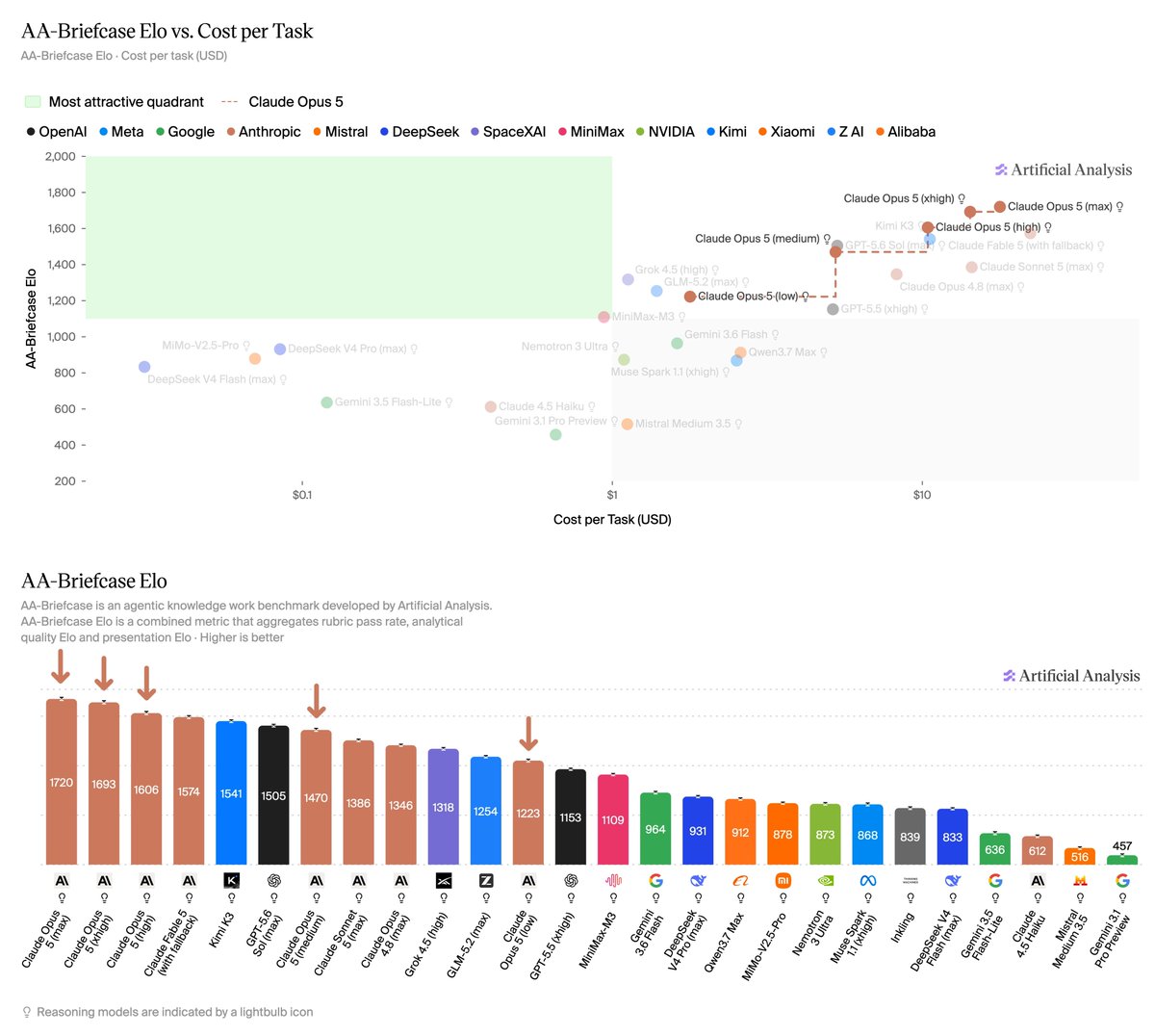
In hands-on testing, Claude Opus 5 generated walkable 3D galleries, physics sims, and games from single prompts with minimal cleanup. It scored 30.2% on ARC-AGI-3 versus ~2% for Opus 4.8 and GPT-5.6, and matched rival output at half to a fifth of the cost.

LaunchAI Models8 sources

DeepSeek-V4-Flash-0731 goes live on DeepSeek API

Per DeepSeek's API changelog, V4-Flash-0731 scores 82.7 on Terminal Bench 2.1, 70.3 on Toolathlon verified, and 25.1 on Automation Bench (Public). It keeps V4-Flash-Preview's architecture and size and was only re-post-trained; the V4-Pro API follows soon. A developer reports building a working game for $0.07 with it.

AnalysisScience2 sources

Why the Legendary Erdős Problems Are Falling to AI

On May 20, 2026, OpenAI announced an internal AI model found a counterexample to Erdős's 1946 unit distance conjecture. On August 1, unreleased model Astra made 10 more advances, solving three further Erdős problems. Princeton's Noga Alon: AI is 'changing dramatically the way mathematical research is being done.'

LaunchMusic3 sources

Suno launches Studio 2.0 with MIDI support and DAW-style tools

Suno Studio 2.0 adds MIDI support, its most requested feature, plus automation, built-in effects, and a session-aware chatbot that can generate lyrics or apply reverb, compression, and EQ. It lacks third-party VST support, relying on a proprietary two-oscillator wavetable synth.

EventPolicy1 source

California bill barring AI chatbots from posing as therapists advances

SB 903 cleared California's Assembly Appropriations Committee 13-0 and would bar companion chatbots from offering psychotherapy without clinician oversight. The Senate passed it 39-0 in May; TechNet's Robert Boykin warned the clinician requirement could delay care amid a statewide behavioral-health worker shortage.

LaunchDevelopers1 source

Flue 2 launches React-style Agent Hooks for building agents

Flue 2, the first stable release of Fred Schott's agent framework, includes 16 built-in React-style hooks — useSkill(), useTool(), useSubagent() — letting agents manage state and attach capabilities at runtime. Schott, creator of Astro (acquired by Cloudflare in January), said no one has built 'the React for agents' yet.

AnalysisAI Models2 sources

MiDashengLM-Gen generates unified audio scenes via LLM-driven flow matching

MiDashengLM-Gen is an end-to-end framework using a pre-trained LLM and audio tokenizer as backbone, with per-token conditional flow matching for autoregressive, variable-length mixed-audio scene generation. It generates coherent 16 kHz audio scenes blending speech, music, and sound effects.

AnalysisPolicy4 sources

METR: LLMs accelerate cyber vulnerability discovery

METR analysis finds cyber vulnerability discovery has accelerated sharply since January 2026, while math results accelerated somewhat and optimizations showed no dramatic change. Data collection was agent-performed; conclusions based on public discoveries only.

AnalysisAI Models1 source

LittleLearner finds LLM capability ceiling with K–5-only training

The project trained 0.6B/1.3B/5B models from scratch on an 88B-token corpus filtered to the U.S. K–5 curriculum, with matched unfiltered controls. Scaling, SFT+GRPO post-training, and in-context learning amplified in-scope skills, but none meaningfully improved out-of-scope performance — the pretraining filter sets the effective capability ceiling.

How-ToDevelopers2 sources

Google shows Gemma 4 E2B running on Raspberry Pi 5 with LiteRT

Google's walkthrough runs Gemma 4 E2B on a Raspberry Pi 5 via LiteRT-LM at 99 tokens/sec prefill and 9 tokens/sec decode, fully on-device. The guide demoes a Reachy Mini robot perceiving and reacting to its environment locally in real time.

LaunchDevelopers1 source

Claude Code adds cross-session messaging between agent sessions

Ships in Claude Code v2.1.224+ on macOS and Linux; sessions discover each other via ListAgents and SendMessage. Claude can message subagents and agent-team teammates, report from long-running migrations/tests, and reply (not initiate) across machines.

AnalysisScience1 source

Study finds dendrites compute information independently within neurons

Research published in Science shows dendrites act as independent processors, significantly expanding the computational capacity of individual neurons beyond the traditional single-unit model. This discovery challenges the assumption that the brain's 86 billion neurons function as simple, singular processors.

LaunchAI Models1 source

Mistral launches OCR 4.1 with paragraph-level bounding boxes

OCR 4.1, Mistral's document parsing service, is in public preview at €3.5/1,000 pages (€4.38/1,000 annotated pages). It adds paragraph-level bounding box extraction, structural block labels, and block-level confidence scores.

AnalysisScience1 source

EarlyDetect AI model forecasts solar eruptions nine hours ahead

Study published Aug. 14 in JGR: Machine Learning and Computation; NJIT-led team with Princeton and NASA Ames collaborators trained EarlyDetect on Solar Dynamics Observatory data, detecting precursor signals in acoustic activity and magnetic fields before active regions emerge. Corresponding author: NJIT undergrad Jonas Tirona.

AnalysisRobotics1 source

How robotics is revolutionizing stroke rehabilitation

Someone in the U.S. has a stroke every 40 seconds, and robotic rehab systems are augmenting traditional therapy by delivering highly repetitive, task-oriented movement to drive neuroplasticity. Bioxtreme's Plaxtreme system uses "error augmentation," deliberately amplifying movement errors so the brain can recognize and correct dysfunctional patterns.

AnalysisScience1 source

Research Assistant: AstraZeneca's Agentic System for R&D

The paper describes AstraZeneca's internal LLM-based agentic system, Research Assistant, which gives scientists and clinicians a chat-style interface to explore biomedical questions across a broad range of data sources.

How-ToAI Models1 source

Building an AI Text Detector From Scratch

Sebastian Raschka's tutorial walks through building a local AI text detector end-to-end, including dataset construction, model training, and RLVR. It also uses the detector as a verifier to train a small language model to avoid detection.

AnalysisDevelopers1 source

Meta Muse Code vs. Fable 5: Cheaper, but at what cost?

Meta released Muse Code on August 5, its first AI coding agent, built on the Muse Spark 1.2 model. Zuckerberg says it handles complete software engineering tasks across large repos, with big jobs fanning out to parallel sub-agents.

LaunchDevelopers1 source

Deltix launches AI-driven iOS testing agent

Deltix is a free AI testing tool that runs plain-English tasks on an iOS simulator, with deterministic Playbook replays and side-by-side build comparisons. It runs locally, never accessing source or signing identities, and supports bring-your-own-model keys.

AnalysisPolicy1 source

Why AI would rather lie than say 'I don't know'

Dwarkesh Patel interviews Ryan Greenblatt on AI's tendency to fabricate answers rather than admit uncertainty, exploring the incentives and risks behind this behavior.

Analysis4 sources

OpenAI design head: best time in history to be a designer

Ian Silber, OpenAI's head of product design, says designers have an edge over AI because there's no training data for the next great product idea. He led design for ChatGPT, Codex, and all of OpenAI's product experience for the past three years.

LaunchLegal1 source

Spellbook launches AI Document Editor for contract redlining

Spellbook launched 'AI Document Editor', letting users instruct it to redline contracts and then manually edit, comment, and fine-tune before sending. It can make hundreds of edits across multiple financing documents based on a term sheet, all within the Associate interface.

EventCybersecurity1 source

Bitcoin firms urge AI labs to grant security researchers model access

Over 40 crypto companies signed an open letter requesting that frontier AI labs provide trusted access to their strongest models for security researchers. Signatories argue that current guardrails hinder defenders from identifying vulnerabilities in open-source financial infrastructure before public release.

AnalysisAI Models1 source

When unlearning is free: low-influence points cut compute ~50%

Apple ML Research proposes an unlearning framework that drops low-influence training points before removal, shrinking the forget set. Across language and vision tasks, computational savings reach up to ~50 percent versus methods that treat all forget-set points equally.

LaunchAI Models11 sources

Liquid AI releases LFM2.5-2.6B on-device agentic model

LFM2.5-2.6B has 2.69B parameters, a 131,072-token context window, and open weights, designed for on-device tool-calling. Community tests report 17-30 tok/s on phones via Q4_K_M GGUF, with benchmarks competitive against models 4x larger.

AnalysisBusiness1 source

Wired podcast breaks down Zuckerberg's 6,500-word AI manifesto

Wired's Uncanny Valley podcast dissects the Meta CEO's 6,500-word AI manifesto, which it says rings hollow, and covers 1 am bot-run job interviews plus Black Hat/Defcon findings including a coin-sized device that can hack a Boeing 737.

LaunchDevelopers4 sources

Claude Code sessions can now message each other

Claude Code v2.1.224 on macOS and Linux sends a summary (not history or files) between sessions, letting one session hand off findings or warn another about breaking changes. Cross-session messages can't approve permissions or change config; /compact arrives as plain text and the receiving session still prompts for approval.

Daily brief

Get tomorrow's AI brief in your inbox